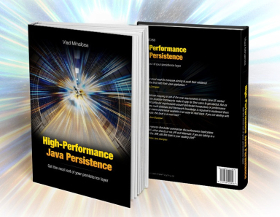
The High-Performance Java Persistence book
Are you struggling with performance issues in your Spring, Jakarta EE, or Java EE application?
Imagine having a tool that could automatically detect performance issues in your JPA and Hibernate data access layer long before pushing a problematic change into production!
With the widespread adoption of AI agents generating code in a heartbeat, having such a tool that can watch your back and prevent performance issues during development, long before they affect production systems, can save your company a lot of money and make you a hero!
Hypersistence Optimizer is that tool, and it works with Spring Boot, Spring Framework, Jakarta EE, Java EE, Quarkus, Micronaut, or Play Framework.
So, rather than allowing performance issues to annoy your customers, you are better off preventing those issues using Hypersistence Optimizer and enjoying spending your time on the things that you love!
A book in the making
It’s been a year since I started the quest for a highly-effective Data Knowledge Stack and the Hibernate Master Class contains over fifty articles already.
Now that I covered many aspects of database transactions, JDBC and Java Persistence, it’s time to assemble all the pieces together into the High-Performance Java Persistence book.
How to monitor a Java EE DataSource
Are you struggling with performance issues in your Spring, Jakarta EE, or Java EE application?
Imagine having a tool that could automatically detect performance issues in your JPA and Hibernate data access layer long before pushing a problematic change into production!
With the widespread adoption of AI agents generating code in a heartbeat, having such a tool that can watch your back and prevent performance issues during development, long before they affect production systems, can save your company a lot of money and make you a hero!
Hypersistence Optimizer is that tool, and it works with Spring Boot, Spring Framework, Jakarta EE, Java EE, Quarkus, Micronaut, or Play Framework.
So, rather than allowing performance issues to annoy your customers, you are better off preventing those issues using Hypersistence Optimizer and enjoying spending your time on the things that you love!
Introduction
FlexyPool is an open-source framework that can monitor a DataSource connection usage. This tool come out of necessity, since we previously lacked support for provisioning connection pools.
FlexyPool was initially designed for stand-alone environments and the DataSource proxy configuration was done programmatically. Using Spring bean aliases, we could even substitute an already configured DataSource with the FlexyPool Metrics-aware proxy alternative.
How does Hibernate Query Cache work
Are you struggling with performance issues in your Spring, Jakarta EE, or Java EE application?
Imagine having a tool that could automatically detect performance issues in your JPA and Hibernate data access layer long before pushing a problematic change into production!
With the widespread adoption of AI agents generating code in a heartbeat, having such a tool that can watch your back and prevent performance issues during development, long before they affect production systems, can save your company a lot of money and make you a hero!
Hypersistence Optimizer is that tool, and it works with Spring Boot, Spring Framework, Jakarta EE, Java EE, Quarkus, Micronaut, or Play Framework.
So, rather than allowing performance issues to annoy your customers, you are better off preventing those issues using Hypersistence Optimizer and enjoying spending your time on the things that you love!
Introduction
Now that I covered both Entity and Collection caching, it’s time to investigate how Query Caching works.
The Query Cache is strictly related to Entities, and it draws an association between a search criterion and the Entities fulfilling that specific query filter. Like other Hibernate features, the Query Cache is not as trivial as one might think.
How does Hibernate TRANSACTIONAL CacheConcurrencyStrategy work
Are you struggling with performance issues in your Spring, Jakarta EE, or Java EE application?
Imagine having a tool that could automatically detect performance issues in your JPA and Hibernate data access layer long before pushing a problematic change into production!
With the widespread adoption of AI agents generating code in a heartbeat, having such a tool that can watch your back and prevent performance issues during development, long before they affect production systems, can save your company a lot of money and make you a hero!
Hypersistence Optimizer is that tool, and it works with Spring Boot, Spring Framework, Jakarta EE, Java EE, Quarkus, Micronaut, or Play Framework.
So, rather than allowing performance issues to annoy your customers, you are better off preventing those issues using Hypersistence Optimizer and enjoying spending your time on the things that you love!
Introduction
In my previous post, I introduced the READ_WRITE second-level cache concurrency mechanism. In this article, I am going to continue this topic with the TRANSACTIONAL strategy.
How does Hibernate READ_WRITE CacheConcurrencyStrategy work
Are you struggling with performance issues in your Spring, Jakarta EE, or Java EE application?
Imagine having a tool that could automatically detect performance issues in your JPA and Hibernate data access layer long before pushing a problematic change into production!
With the widespread adoption of AI agents generating code in a heartbeat, having such a tool that can watch your back and prevent performance issues during development, long before they affect production systems, can save your company a lot of money and make you a hero!
Hypersistence Optimizer is that tool, and it works with Spring Boot, Spring Framework, Jakarta EE, Java EE, Quarkus, Micronaut, or Play Framework.
So, rather than allowing performance issues to annoy your customers, you are better off preventing those issues using Hypersistence Optimizer and enjoying spending your time on the things that you love!
Introduction
In my previous post, I introduced the NONSTRICT_READ_WRITE second-level cache concurrency mechanism. In this article, I am going to continue this topic with the READ_WRITE strategy.
How does Hibernate NONSTRICT_READ_WRITE CacheConcurrencyStrategy work
Are you struggling with performance issues in your Spring, Jakarta EE, or Java EE application?
Imagine having a tool that could automatically detect performance issues in your JPA and Hibernate data access layer long before pushing a problematic change into production!
With the widespread adoption of AI agents generating code in a heartbeat, having such a tool that can watch your back and prevent performance issues during development, long before they affect production systems, can save your company a lot of money and make you a hero!
Hypersistence Optimizer is that tool, and it works with Spring Boot, Spring Framework, Jakarta EE, Java EE, Quarkus, Micronaut, or Play Framework.
So, rather than allowing performance issues to annoy your customers, you are better off preventing those issues using Hypersistence Optimizer and enjoying spending your time on the things that you love!
Introduction
In my previous post, I introduced the READ_ONLY CacheConcurrencyStrategy, which is the obvious choice for immutable entity graphs. When cached data is changeable, we need to use a read-write caching strategy and this post will describe how NONSTRICT_READ_WRITE second-level cache works.
How does Hibernate Collection Cache work
Are you struggling with performance issues in your Spring, Jakarta EE, or Java EE application?
Imagine having a tool that could automatically detect performance issues in your JPA and Hibernate data access layer long before pushing a problematic change into production!
With the widespread adoption of AI agents generating code in a heartbeat, having such a tool that can watch your back and prevent performance issues during development, long before they affect production systems, can save your company a lot of money and make you a hero!
Hypersistence Optimizer is that tool, and it works with Spring Boot, Spring Framework, Jakarta EE, Java EE, Quarkus, Micronaut, or Play Framework.
So, rather than allowing performance issues to annoy your customers, you are better off preventing those issues using Hypersistence Optimizer and enjoying spending your time on the things that you love!
Introduction
Previously, I described the second-level cache entry structure, Hibernate uses for storing entities. Besides entities, Hibernate can also store entity associations and this article will unravel the inner workings of collection caching.
How does Hibernate READ_ONLY CacheConcurrencyStrategy work
Are you struggling with performance issues in your Spring, Jakarta EE, or Java EE application?
Imagine having a tool that could automatically detect performance issues in your JPA and Hibernate data access layer long before pushing a problematic change into production!
With the widespread adoption of AI agents generating code in a heartbeat, having such a tool that can watch your back and prevent performance issues during development, long before they affect production systems, can save your company a lot of money and make you a hero!
Hypersistence Optimizer is that tool, and it works with Spring Boot, Spring Framework, Jakarta EE, Java EE, Quarkus, Micronaut, or Play Framework.
So, rather than allowing performance issues to annoy your customers, you are better off preventing those issues using Hypersistence Optimizer and enjoying spending your time on the things that you love!
Introduction
As I previously explained, enterprise caching requires diligence. Because data is duplicated between the database (system of record) and the caching layer, we need to make sure the two separate data sources don’t drift apart.
If the cached data is immutable (neither the database nor the cache is able to modify it), we can safely cache it without worrying about any consistency issues. Read-only data is always a good candidate for application-level caching, improving read performance without having to relax consistency guarantees.
A beginner’s guide to Cache synchronization strategies
Are you struggling with performance issues in your Spring, Jakarta EE, or Java EE application?
Imagine having a tool that could automatically detect performance issues in your JPA and Hibernate data access layer long before pushing a problematic change into production!
With the widespread adoption of AI agents generating code in a heartbeat, having such a tool that can watch your back and prevent performance issues during development, long before they affect production systems, can save your company a lot of money and make you a hero!
Hypersistence Optimizer is that tool, and it works with Spring Boot, Spring Framework, Jakarta EE, Java EE, Quarkus, Micronaut, or Play Framework.
So, rather than allowing performance issues to annoy your customers, you are better off preventing those issues using Hypersistence Optimizer and enjoying spending your time on the things that you love!
Introduction
A system of record is the authoritative data source when information is scattered among various data providers. When we introduce a caching solution, we automatically duplicate our data. To avoid inconsistent reads and data integrity issues, it’s very important to synchronize the database and the cache (whenever a change occurs in the system).
There are various ways to keep the cache and the underlying database in sync and this article will present some of the most common cache synchronization strategies.