Things to consider before jumping to application-level caching
Are you struggling with performance issues in your Spring, Jakarta EE, or Java EE application?
Imagine having a tool that could automatically detect performance issues in your JPA and Hibernate data access layer long before pushing a problematic change into production!
With the widespread adoption of AI agents generating code in a heartbeat, having such a tool that can watch your back and prevent performance issues during development, long before they affect production systems, can save your company a lot of money and make you a hero!
Hypersistence Optimizer is that tool, and it works with Spring Boot, Spring Framework, Jakarta EE, Java EE, Quarkus, Micronaut, or Play Framework.
So, rather than allowing performance issues to annoy your customers, you are better off preventing those issues using Hypersistence Optimizer and enjoying spending your time on the things that you love!
Introduction
Relational database transactions are ACID and the strong consistency model simplifies application development. Because enabling Hibernate caching is one configuration away, it’s very appealing to turn to caching whenever the data access layer starts showing performance issues. Adding a caching layer can indeed improve application performance, but it has its price and you need to be aware of it.
How does Hibernate store second-level cache entries
Are you struggling with performance issues in your Spring, Jakarta EE, or Java EE application?
Imagine having a tool that could automatically detect performance issues in your JPA and Hibernate data access layer long before pushing a problematic change into production!
With the widespread adoption of AI agents generating code in a heartbeat, having such a tool that can watch your back and prevent performance issues during development, long before they affect production systems, can save your company a lot of money and make you a hero!
Hypersistence Optimizer is that tool, and it works with Spring Boot, Spring Framework, Jakarta EE, Java EE, Quarkus, Micronaut, or Play Framework.
So, rather than allowing performance issues to annoy your customers, you are better off preventing those issues using Hypersistence Optimizer and enjoying spending your time on the things that you love!
Introduction
The benefit of using a database access abstraction layer is that caching can be implemented transparently, without leaking into the business logic code. Hibernate Persistence Context acts as a transactional write-behind cache, translating entity state transitions into DML statements.
The Persistence Context acts as a logical transaction storage, and each Entity instance can have at-most one managed reference. No matter how many times we try to load the same Entity, the Hibernate Session will always return the same object reference. This behavior is generally depicted as the first-level cache.
The Hibernate Persistence Context is not a caching solution per se, serving a different purpose than boosting application read operation performance. Because the Hibernate Session is bound to the currently running logical transaction, once the transaction is over, the Session is being destroyed.
JDBC Statement fetchSize property
Are you struggling with performance issues in your Spring, Jakarta EE, or Java EE application?
Imagine having a tool that could automatically detect performance issues in your JPA and Hibernate data access layer long before pushing a problematic change into production!
With the widespread adoption of AI agents generating code in a heartbeat, having such a tool that can watch your back and prevent performance issues during development, long before they affect production systems, can save your company a lot of money and make you a hero!
Hypersistence Optimizer is that tool, and it works with Spring Boot, Spring Framework, Jakarta EE, Java EE, Quarkus, Micronaut, or Play Framework.
So, rather than allowing performance issues to annoy your customers, you are better off preventing those issues using Hypersistence Optimizer and enjoying spending your time on the things that you love!
Introduction
In this article, we are going to see how the JDBC Statement fetchSize property works when using Oracle, SQL Server, PostgreSQL, or MySQL.
JDBC ResultSet fetching
The JDBC ResultSet offers a client-side cursor for fetching the current statement return data.
When the statement gets executed, the result must be transferred from the database cursor to the client-side one. This operation can either be done at once or on demand.
How to batch DELETE statements with Hibernate
Are you struggling with performance issues in your Spring, Jakarta EE, or Java EE application?
Imagine having a tool that could automatically detect performance issues in your JPA and Hibernate data access layer long before pushing a problematic change into production!
With the widespread adoption of AI agents generating code in a heartbeat, having such a tool that can watch your back and prevent performance issues during development, long before they affect production systems, can save your company a lot of money and make you a hero!
Hypersistence Optimizer is that tool, and it works with Spring Boot, Spring Framework, Jakarta EE, Java EE, Quarkus, Micronaut, or Play Framework.
So, rather than allowing performance issues to annoy your customers, you are better off preventing those issues using Hypersistence Optimizer and enjoying spending your time on the things that you love!
Introduction
In my previous post, I explained the Hibernate configurations required for batching INSERT and UPDATE statements. This post will continue this topic with DELETE statements batching.
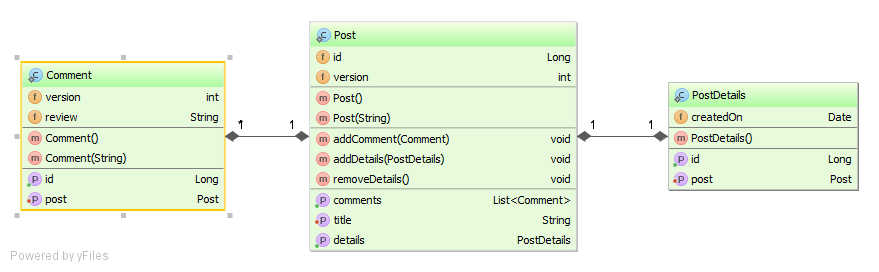
Domain model entities
We’ll start with the following entity model:
How to batch INSERT and UPDATE statements with Hibernate
Are you struggling with performance issues in your Spring, Jakarta EE, or Java EE application?
Imagine having a tool that could automatically detect performance issues in your JPA and Hibernate data access layer long before pushing a problematic change into production!
With the widespread adoption of AI agents generating code in a heartbeat, having such a tool that can watch your back and prevent performance issues during development, long before they affect production systems, can save your company a lot of money and make you a hero!
Hypersistence Optimizer is that tool, and it works with Spring Boot, Spring Framework, Jakarta EE, Java EE, Quarkus, Micronaut, or Play Framework.
So, rather than allowing performance issues to annoy your customers, you are better off preventing those issues using Hypersistence Optimizer and enjoying spending your time on the things that you love!
Introduction
JDBC has long been offering support for DML statement batching. By default, all statements are sent one after the other, each one in a separate network round-trip. Batching allows us to send multiple statements in one-shot, saving unnecessary socket stream flushing.
Hibernate hides the database statements behind a transactional write-behind abstraction layer. An intermediate layer allows us to hide the JDBC batching semantics from the persistence layer logic. This way, we can change the JDBC batching strategy without altering the data access code.
Configuring Hibernate to support JDBC batching is not as easy as it should be, so I’m going to explain everything you need to do in order to make it work.
How does CascadeType.LOCK works in JPA and Hibernate
Are you struggling with performance issues in your Spring, Jakarta EE, or Java EE application?
Imagine having a tool that could automatically detect performance issues in your JPA and Hibernate data access layer long before pushing a problematic change into production!
With the widespread adoption of AI agents generating code in a heartbeat, having such a tool that can watch your back and prevent performance issues during development, long before they affect production systems, can save your company a lot of money and make you a hero!
Hypersistence Optimizer is that tool, and it works with Spring Boot, Spring Framework, Jakarta EE, Java EE, Quarkus, Micronaut, or Play Framework.
So, rather than allowing performance issues to annoy your customers, you are better off preventing those issues using Hypersistence Optimizer and enjoying spending your time on the things that you love!
Introduction
Having introduced Hibernate explicit locking support, as well as Cascade Types, it’s time to analyze the CascadeType.LOCK behavior.
A Hibernate lock request triggers an internal LockEvent. The associated DefaultLockEventListener may cascade the lock request to the locking entity children.
Since CascadeType.ALL includes CascadeType.LOCK too, it’s worth understanding when a lock request propagates from a Parent to a Child entity.
A beginner’s guide to JPA and Hibernate Cascade Types
Are you struggling with performance issues in your Spring, Jakarta EE, or Java EE application?
Imagine having a tool that could automatically detect performance issues in your JPA and Hibernate data access layer long before pushing a problematic change into production!
With the widespread adoption of AI agents generating code in a heartbeat, having such a tool that can watch your back and prevent performance issues during development, long before they affect production systems, can save your company a lot of money and make you a hero!
Hypersistence Optimizer is that tool, and it works with Spring Boot, Spring Framework, Jakarta EE, Java EE, Quarkus, Micronaut, or Play Framework.
So, rather than allowing performance issues to annoy your customers, you are better off preventing those issues using Hypersistence Optimizer and enjoying spending your time on the things that you love!
Introduction
In this article, we are going to learn how the JPA and Hibernate Cascade Types work.
JPA translates entity state transitions to database DML statements. Because it’s common to operate on entity graphs, JPA allows us to propagate entity state changes from Parents to Child entities.
This behavior is configured through the CascadeType mappings.
How do LockModeType.PESSIMISTIC_READ and LockModeType.PESSIMISTIC_WRITE work in JPA and Hibernate
Are you struggling with performance issues in your Spring, Jakarta EE, or Java EE application?
Imagine having a tool that could automatically detect performance issues in your JPA and Hibernate data access layer long before pushing a problematic change into production!
With the widespread adoption of AI agents generating code in a heartbeat, having such a tool that can watch your back and prevent performance issues during development, long before they affect production systems, can save your company a lot of money and make you a hero!
Hypersistence Optimizer is that tool, and it works with Spring Boot, Spring Framework, Jakarta EE, Java EE, Quarkus, Micronaut, or Play Framework.
So, rather than allowing performance issues to annoy your customers, you are better off preventing those issues using Hypersistence Optimizer and enjoying spending your time on the things that you love!
Introduction
Java Persistence API comes with a thorough concurrency control mechanism, supporting both implicit and explicit locking. The implicit locking mechanism is straightforward and it relies on:
- Optimistic locking: Entity state changes can trigger a version incrementation
- Row-level locking: Based on the current running transaction isolation level, the INSERT/UPDATE/DELETE statements may acquire exclusive row locks
While implicit locking is suitable for many scenarios, an explicit locking mechanism can leverage a finer-grained concurrency control.
In my previous posts, I covered the explicit optimistic lock modes:
In this post, I am going to unravel the explicit pessimistic lock modes:
How does LockModeType.PESSIMISTIC_FORCE_INCREMENT work in JPA and Hibernate
Are you struggling with performance issues in your Spring, Jakarta EE, or Java EE application?
Imagine having a tool that could automatically detect performance issues in your JPA and Hibernate data access layer long before pushing a problematic change into production!
With the widespread adoption of AI agents generating code in a heartbeat, having such a tool that can watch your back and prevent performance issues during development, long before they affect production systems, can save your company a lot of money and make you a hero!
Hypersistence Optimizer is that tool, and it works with Spring Boot, Spring Framework, Jakarta EE, Java EE, Quarkus, Micronaut, or Play Framework.
So, rather than allowing performance issues to annoy your customers, you are better off preventing those issues using Hypersistence Optimizer and enjoying spending your time on the things that you love!
Introduction
In my previous post, I introduced the OPTIMISTIC_FORCE_INCREMENT Lock Mode and we applied it for propagating a child entity version change to a locked parent entity. In this post, I am going to reveal the PESSIMISTIC_FORCE_INCREMENT Lock Mode and compare it with its optimistic counterpart.
The best way to use OPTIMISTIC_FORCE_INCREMENT with JPA and Hibernate
Are you struggling with performance issues in your Spring, Jakarta EE, or Java EE application?
Imagine having a tool that could automatically detect performance issues in your JPA and Hibernate data access layer long before pushing a problematic change into production!
With the widespread adoption of AI agents generating code in a heartbeat, having such a tool that can watch your back and prevent performance issues during development, long before they affect production systems, can save your company a lot of money and make you a hero!
Hypersistence Optimizer is that tool, and it works with Spring Boot, Spring Framework, Jakarta EE, Java EE, Quarkus, Micronaut, or Play Framework.
So, rather than allowing performance issues to annoy your customers, you are better off preventing those issues using Hypersistence Optimizer and enjoying spending your time on the things that you love!
Introduction
In this article we are going to see what is the best way to use the OPTIMISTIC_FORCE_INCREMENT LockModeType with JPA and Hibernate.
With LockModeType.OPTIMISTIC, the locked entity version is checked towards the end of the current running transaction, to make sure we don’t use a stale entity state. Because of the application-level validation nature, this strategy is susceptible to race-conditions, therefore requiring an additional pessimistic lock .
The LockModeType.OPTIMISTIC_FORCE_INCREMENT not only it checks the expected locked entity version, but it also increments it. Both the check and the update happen in the same UPDATE statement, therefore making use of the current database transaction isolation level and the associated physical locking guarantees.
It is worth noting that the locked entity version is bumped up even if the entity state hasn’t been changed by the current running transaction.