What’s new in JPA 2.2 – Java 8 Date and Time Types
Are you struggling with performance issues in your Spring, Jakarta EE, or Java EE application?
Imagine having a tool that could automatically detect performance issues in your JPA and Hibernate data access layer long before pushing a problematic change into production!
With the widespread adoption of AI agents generating code in a heartbeat, having such a tool that can watch your back and prevent performance issues during development, long before they affect production systems, can save your company a lot of money and make you a hero!
Hypersistence Optimizer is that tool, and it works with Spring Boot, Spring Framework, Jakarta EE, Java EE, Quarkus, Micronaut, or Play Framework.
So, rather than allowing performance issues to annoy your customers, you are better off preventing those issues using Hypersistence Optimizer and enjoying spending your time on the things that you love!
Introduction
In this article, we are going to see how JPA 2.2 Date/Time works, and which types you need to use depending on your business case requirements.
Java 8 Date/Time support
The JPA 2.2 change log says that only the following types are going to be supported:
java.time.LocalDatejava.time.LocalTimejava.time.LocalDateTimejava.time.OffsetTimejava.time.OffsetDateTime
While LocalDateTime is rather straightforward since it only captures a date and time reference, OffsetDateTime is more problematic because it only captures the offset, but not the time zone rules such as DST (Daylight Saving Time) or other rules defined by ZoneId and typically supported by ZonedDateTime.
It’s also curious that the standard does not support the java.time.Duration type which can come in handy in many business use cases.
Domain Model
Considering we have following entities in our system:
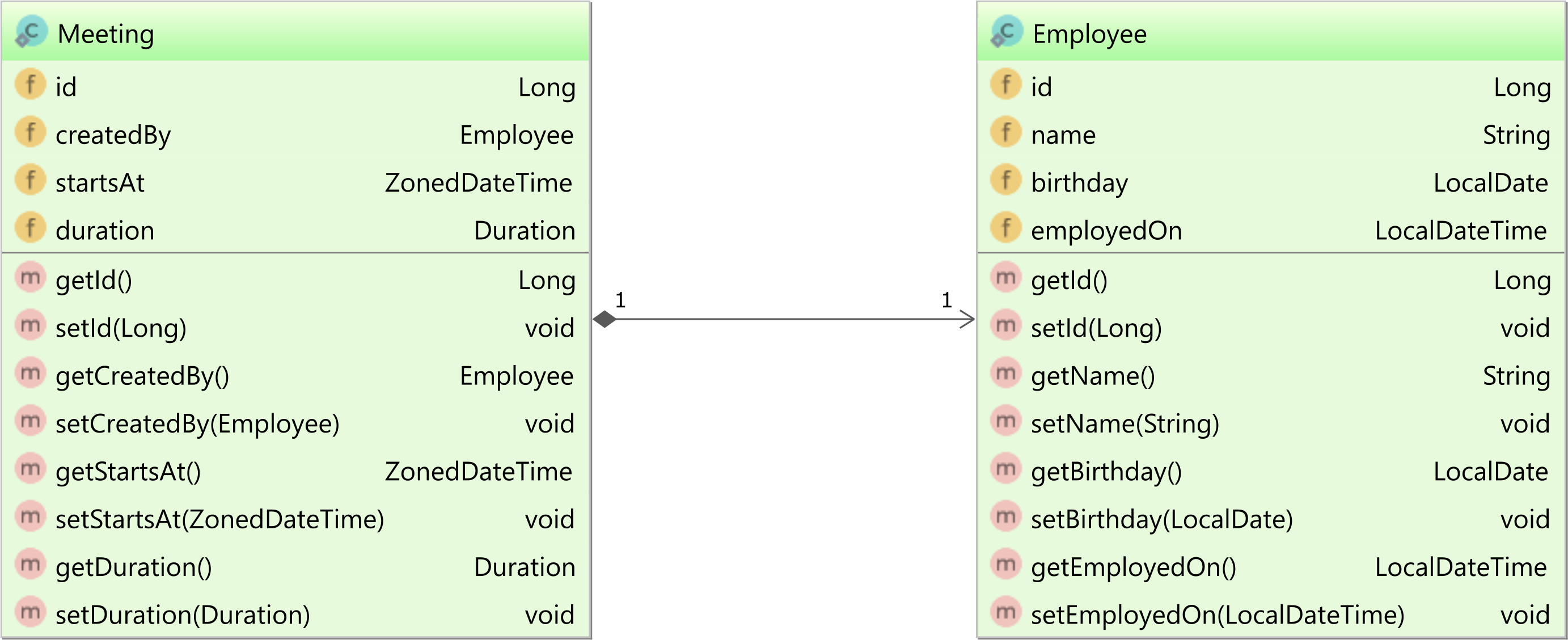
The Employee entity contains the following Java 8 Date Time attributes:
birthdayattribute is aLocalDatesince we are only interested in the Date partupdatedOnis aLocalDateTimesince this attribute needs to store both Date and Time information
@Entity(name = "Employee")
public class Employee {

    @Id
    @GeneratedValue
    private Long id;

    @NaturalId
    private String name;

    private LocalDate birthday;

    @Column(name = "updated_on")
    private LocalDateTime updatedOn;

    //Getters are setters omitted for brevity
}
For more details about the
@NaturalIdannotation, check out this article.
The Meeting entity features the following Java 8 Date Time attributes:
startsAtis aZoneDateTimewhich, even if not supported by JPA 2.2, is probably a more suitable version ofOffsetDateTime- the
durationattribute might not be supported by JPA 2.2, but we will use it since Hibernate supports all these types
@Entity(name = "Meeting")
public class Meeting {

    @Id
    private Long id;

    @ManyToOne(fetch = FetchType.LAZY)
    @JoinColumn(name = "employee_id")
    private Employee createdBy;

    @Column(name = "starts_at")
    private ZonedDateTime startsAt;

    private Duration duration;

    //Getters are setters omitted for brevity
}
Testing time
Assuming we persist the following entities:
Employee employee = new Employee();
employee.setName( "Vlad Mihalcea" );
employee.setBirthday(
    LocalDate.of(
        1981, 12, 10
    )
);
employee.setUpdatedOn(
    LocalDateTime.of(
        2015, 12, 1,
        8, 0, 0
    )
);

entityManager.persist( employee );

Meeting meeting = new Meeting();
meeting.setId( 1L );
meeting.setCreatedBy( employee );
meeting.setStartsAt(
    ZonedDateTime.of(
        2017, 6, 25,
        11, 30, 0, 0,
        ZoneId.systemDefault()
    )
);
meeting.setDuration(
    Duration.of( 45, ChronoUnit.MINUTES )
);

entityManager.persist( meeting );
Hibernate is going to generate the following SQL statements:
INSERT INTO Employee (
    birthday,
    name,
    updated_on,
    id
)
VALUES (
    '1981-12-10',
    'Vlad Mihalcea',
    '2015-12-01 08:00:00.0',
    1
)

INSERT INTO Meeting (
    employee_id,
    duration,
    starts_at,
    id
)
VALUES (
    1,
    2700000000000,
    '2017-06-25 11:30:00.0',
    1
)
Both
LocalDateTimeandZonedDateTimeshare theorg.hibernate.type.descriptor.sql.TimestampTypeDescriptor, meaning that they are going to be persisted asjava.sql.Timestamp.While
LocalDateTimelacks any time zone info, theZonedDateTimeis going to lose the time zone information when being saved to the associated database column.
When loading back our entities:
Employee employee = entityManager
.unwrap( Session.class )
.bySimpleNaturalId( Employee.class )
.load( "Vlad Mihalcea" );

assertEquals(
    LocalDate.of(
        1981, 12, 10
    ),
    employee.getBirthday()
);
assertEquals(
    LocalDateTime.of(
        2015, 12, 1,
        8, 0, 0
    ),
    employee.getUpdatedOn()
);

Meeting meeting = entityManager.find( Meeting.class, 1L );
assertSame(
    employee, meeting.getCreatedBy()
);
assertEquals(
    ZonedDateTime.of(
        2017, 6, 25,
        11, 30, 0, 0,
        ZoneId.systemDefault()
    ),
    meeting.getStartsAt()
);
assertEquals(
    Duration.of( 45, ChronoUnit.MINUTES ),
    meeting.getDuration()
);
The original Java 8 Data Time objects match the ones being persisted.
If you enjoyed this article, I bet you are going to love my Book and Video Courses as well.



Conclusion
The reason why ZonedDateTime equals the one we previously saved is because the underlying TIMESTAMP value was transposed in the current System Time Zone.
Until all JDBC Drivers will support TIMESTAMP WITH TIMEZONE at the java.sql.Statement parameter value binding level which is a requirement for HHH-11773, it’s doubtful that you really need to use ZonedDateTime or OffsetDateTime.
Currently, it’s much wiser to save all TIMESTAMP values in UTC, meaning that LocalDateTime is a much better fit for your JPA entities.