
Transactions and Concurrency Control
Are you struggling with performance issues in your Spring, Jakarta EE, or Java EE application?
What if there were a tool that could automatically detect what caused performance issues in your JPA and Hibernate data access layer?
Wouldn’t it be awesome to have such a tool to watch your application and prevent performance issues during development, long before they affect production systems?
Well, Hypersistence Optimizer is that tool! And it works with Spring Boot, Spring Framework, Jakarta EE, Java EE, Quarkus, Micronaut, or Play Framework.
So, rather than fixing performance issues in your production system on a Saturday night, you are better off using Hypersistence Optimizer to help you prevent those issues so that you can spend your time on the things that you love!
For a simple many-to-many database relationship, you can use the @ManyToMany JPA annotation and, therefore, hide the join table.
However, sometimes you need more than the two Foreign Key columns in the join table, and, for this purpose, you need to replace the @ManyToMany association with two bidirectional @OneToMany associations. Unlike unidirectional @OneToMany, the bidirectional relationship is the best way to map a one-to-many database relationship that requires a collection of Child elements on the parent side
In this article, we are going to see how you can map a many-to-many database relationship using an intermediary entity for the join table. This way, we can map additional columns that would be otherwise impossible to persist using the @ManyToMany JPA annotation.
Assuming we have the following database tables:

The first thing we need is to map the composite Primary Key which belongs to the intermediary join table. As explained in this article, we need an @Embeddable type to hold the composite entity identifier:
@Embeddable
public class PostTagId
    implements Serializable {

    @Column(name = "post_id")
    private Long postId;

    @Column(name = "tag_id")
    private Long tagId;

    private PostTagId() {}

    public PostTagId(
        Long postId,
        Long tagId) {
        this.postId = postId;
        this.tagId = tagId;
    }

    //Getters omitted for brevity

    @Override
    public boolean equals(Object o) {
        if (this == o) return true;

        if (o == null || getClass() != o.getClass())
            return false;

        PostTagId that = (PostTagId) o;
        return Objects.equals(postId, that.postId) &&
               Objects.equals(tagId, that.tagId);
    }

    @Override
    public int hashCode() {
        return Objects.hash(postId, tagId);
    }
}
There are two very important aspects to take into consideration when mapping an @Embeddable composite identifier:
@Embeddable type to be Serializable@Embeddable type must override the default equals and hashCode methods based on the two Primary Key identifier values.Next, we need to map the join table using a dedicated entity:
@Entity(name = "PostTag")
@Table(name = "post_tag")
public class PostTag {

    @EmbeddedId
    private PostTagId id;

    @ManyToOne(fetch = FetchType.LAZY)
    @MapsId("postId")
    private Post post;

    @ManyToOne(fetch = FetchType.LAZY)
    @MapsId("tagId")
    private Tag tag;

    @Column(name = "created_on")
    private Date createdOn = new Date();

    private PostTag() {}

    public PostTag(Post post, Tag tag) {
        this.post = post;
        this.tag = tag;
        this.id = new PostTagId(post.getId(), tag.getId());
    }

    //Getters and setters omitted for brevity

    @Override
    public boolean equals(Object o) {
        if (this == o) return true;

        if (o == null || getClass() != o.getClass())
            return false;

        PostTag that = (PostTag) o;
        return Objects.equals(post, that.post) &&
               Objects.equals(tag, that.tag);
    }

    @Override
    public int hashCode() {
        return Objects.hash(post, tag);
    }
}
The Tag entity is going to map the @OneToMany side for the tag attribute in the PostTag join entity:
@Entity(name = "Tag")
@Table(name = "tag")
@NaturalIdCache
@Cache(
    usage = CacheConcurrencyStrategy.READ_WRITE
)
public class Tag {

    @Id
    @GeneratedValue
    private Long id;

    @NaturalId
    private String name;

    @OneToMany(
        mappedBy = "tag",
        cascade = CascadeType.ALL,
        orphanRemoval = true
    )
    private List<PostTag> posts = new ArrayList<>();

    public Tag() {
    }

    public Tag(String name) {
        this.name = name;
    }

    //Getters and setters omitted for brevity

    @Override
    public boolean equals(Object o) {
        if (this == o) return true;
        if (o == null || getClass() != o.getClass()) return false;
        Tag tag = (Tag) o;
        return Objects.equals(name, tag.name);
    }

    @Override
    public int hashCode() {
        return Objects.hash(name);
    }
}
The Tag entity is marked with the following Hibernate-specific annotations:
@NaturalId annotation allows us to fetch the Tag entity by its business key.@Cache annotation marks the cache concurrency strategy.@NaturalIdCache tells Hibernate to cache the entity identifier associated with a given business key.For more details about the
@NaturalIdand@NaturalIdCacheannotations, check out this article.
With these annotations in place, we can fetch the Tag entity without needing to hit the database.
And the Post entity is going to map the @OneToMany side for the post attribute in the PostTag join entity:
@Entity(name = "Post")
@Table(name = "post")
public class Post {

    @Id
    @GeneratedValue
    private Long id;

    private String title;

    @OneToMany(
        mappedBy = "post",
        cascade = CascadeType.ALL,
        orphanRemoval = true
    )
    private List<PostTag> tags = new ArrayList<>();

    public Post() {
    }

    public Post(String title) {
        this.title = title;
    }

    //Getters and setters omitted for brevity

    public void addTag(Tag tag) {
        PostTag postTag = new PostTag(this, tag);
        tags.add(postTag);
        tag.getPosts().add(postTag);
    }

    public void removeTag(Tag tag) {
        for (Iterator<PostTag> iterator = tags.iterator();
             iterator.hasNext(); ) {
            PostTag postTag = iterator.next();

            if (postTag.getPost().equals(this) &&
                    postTag.getTag().equals(tag)) {
                iterator.remove();
                postTag.getTag().getPosts().remove(postTag);
                postTag.setPost(null);
                postTag.setTag(null);
            }
        }
    }

    @Override
    public boolean equals(Object o) {
        if (this == o) return true;
        if (!(o instanceof Post)) return false;
        return id != null && id.equals(((Post) o).getId());
    }

    @Override
    public int hashCode() {
        return getClass().hashCode();
    }
}
Notice that the Post entity features the addTag and removeTag utility methods which are needed by every bidirectional association so that all sides of the association stay in sync.
While we could have added the same add/remove methods to the Tag entity, it’s unlikely that these associations will be set from the Tag entity because the users operate with Post entities.
To better visualize the entity relationships, check out the following diagram:

First, let’s persist some Tag entities which we’ll later associate to a Post:
Tag misc = new Tag("Misc");
Tag jdbc = new Tag("JDBC");
Tag hibernate = new Tag("Hibernate");
Tag jooq = new Tag("jOOQ");

doInJPA(entityManager -> {
    entityManager.persist( misc );
    entityManager.persist( jdbc );
    entityManager.persist( hibernate );
    entityManager.persist( jooq );
});
Now, when we persist two Post entities:
Session session = entityManager
    .unwrap( Session.class );

Tag misc = session
    .bySimpleNaturalId(Tag.class)
    .load( "Misc" );

Tag jdbc = session
    .bySimpleNaturalId(Tag.class)
    .load( "JDBC" );

Tag hibernate = session
    .bySimpleNaturalId(Tag.class)
    .load( "Hibernate" );

Tag jooq = session
    .bySimpleNaturalId(Tag.class)
    .load( "jOOQ" );

Post hpjp1 = new Post(
    "High-Performance Java Persistence 1st edition"
);
hpjp1.setId(1L);

hpjp1.addTag(jdbc);
hpjp1.addTag(hibernate);
hpjp1.addTag(jooq);
hpjp1.addTag(misc);

entityManager.persist(hpjp1);

Post hpjp2 = new Post(
    "High-Performance Java Persistence 2nd edition"
);
hpjp2.setId(2L);

hpjp2.addTag(jdbc);
hpjp2.addTag(hibernate);
hpjp2.addTag(jooq);

entityManager.persist(hpjp2);
Hibernate generates the following SQL statements:
INSERT INTO post (title, id)
VALUES ('High-Performance Java Persistence 1st edition', 1)

INSERT INTO post_tag (created_on, post_id, tag_id)
VALUES ('2017-07-26 13:14:08.988', 1, 2)

INSERT INTO post_tag (created_on, post_id, tag_id)
VALUES ('2017-07-26 13:14:08.989', 1, 3)

INSERT INTO post_tag (created_on, post_id, tag_id)
VALUES ('2017-07-26 13:14:08.99', 1, 4)

INSERT INTO post_tag (created_on, post_id, tag_id)
VALUES ('2017-07-26 13:14:08.99', 1, 1)

INSERT INTO post (title, id)
VALUES ('High-Performance Java Persistence 2nd edition', 2)

INSERT INTO post_tag (created_on, post_id, tag_id)
VALUES ('2017-07-26 13:14:08.992', 2, 3)

INSERT INTO post_tag (created_on, post_id, tag_id)
VALUES ('2017-07-26 13:14:08.992', 2, 4)

INSERT INTO post_tag (created_on, post_id, tag_id)
VALUES ('2017-07-26 13:14:08.992', 2, 2)
Now, since the Misc Tag entity was added by mistake, we can remove it as follows:
Tag misc = entityManager.unwrap( Session.class )
    .bySimpleNaturalId(Tag.class)
    .load( "Misc" );

Post post = entityManager.createQuery(
    "select p " +
    "from Post p " +
    "join fetch p.tags pt " +
    "join fetch pt.tag " +
    "where p.id = :postId", Post.class)
.setParameter( "postId", 1L )
.getSingleResult();

post.removeTag( misc );
Hibernate generates the following SQL statements:
SELECT p.id AS id1_0_0_,
       p_t.created_on AS created_1_1_1_,
       p_t.post_id AS post_id2_1_1_,
       p_t.tag_id AS tag_id3_1_1_,
       t.id AS id1_2_2_,
       p.title AS title2_0_0_,
       p_t.post_id AS post_id2_1_0__,
       p_t.created_on AS created_1_1_0__,
       p_t.tag_id AS tag_id3_1_0__,
       t.name AS name2_2_2_
FROM   post p
INNER JOIN
       post_tag p_t ON p.id = p_t.post_id
INNER JOIN
       tag t ON p_t.tag_id = t.id
WHERE  p.id = 1

SELECT p_t.tag_id AS tag_id3_1_0_,
       p_t.created_on AS created_1_1_0_,
       p_t.post_id AS post_id2_1_0_,
       p_t.created_on AS created_1_1_1_,
       p_t.post_id AS post_id2_1_1_,
       p_t.tag_id AS tag_id3_1_1_
FROM   post_tag p_t
WHERE  p_t.tag_id = 1

DELETE
FROM   post_tag
WHERE  post_id = 1 AND tag_id = 1
The second SELECT query is needed by this line in the removeTag utility method:
postTag.getTag().getPosts().remove(postTag);
However, if you don’t need to navigate all Post entities associated with a Tag, you can remove the posts collection from the Tag entity and this secondary SELECT statement will not be executed anymore.
I also published a YouTube video about the @ManyToMany association with extra columns, so enjoy watching it if you’re interested in this topic.
The Tag entity will not map the PostTag @OneToMany bidirectional association anymore.
@Entity(name = "Tag")
@Table(name = "tag")
@NaturalIdCache
@Cache(usage = CacheConcurrencyStrategy.READ_WRITE)
public class Tag {

    @Id
    @GeneratedValue
    private Long id;

    @NaturalId
    private String name;

    public Tag() {
    }

    public Tag(String name) {
        this.name = name;
    }

    //Getters omitted for brevity

    @Override
    public boolean equals(Object o) {
        if (this == o) return true;

        if (o == null || getClass() != o.getClass())
            return false;

        Tag tag = (Tag) o;
        return Objects.equals(name, tag.name);
    }

    @Override
    public int hashCode() {
        return Objects.hash(name);
    }
}
The PostTag entity and its PostTagId @Embeddable are identical to the previous example.
However, the Post entity addTag and removeTag are simplified as follows:
public void addTag(Tag tag) {
    PostTag postTag = new PostTag(this, tag);
    tags.add(postTag);
}

public void removeTag(Tag tag) {
    for (Iterator<PostTag> iterator = tags.iterator();
         iterator.hasNext(); ) {
        PostTag postTag = iterator.next();

        if (postTag.getPost().equals(this) &&
                postTag.getTag().equals(tag)) {
            iterator.remove();
            postTag.setPost(null);
            postTag.setTag(null);
        }
    }
}
The rest of the Post entity is the same as in the previous example, as seen in the following diagram:
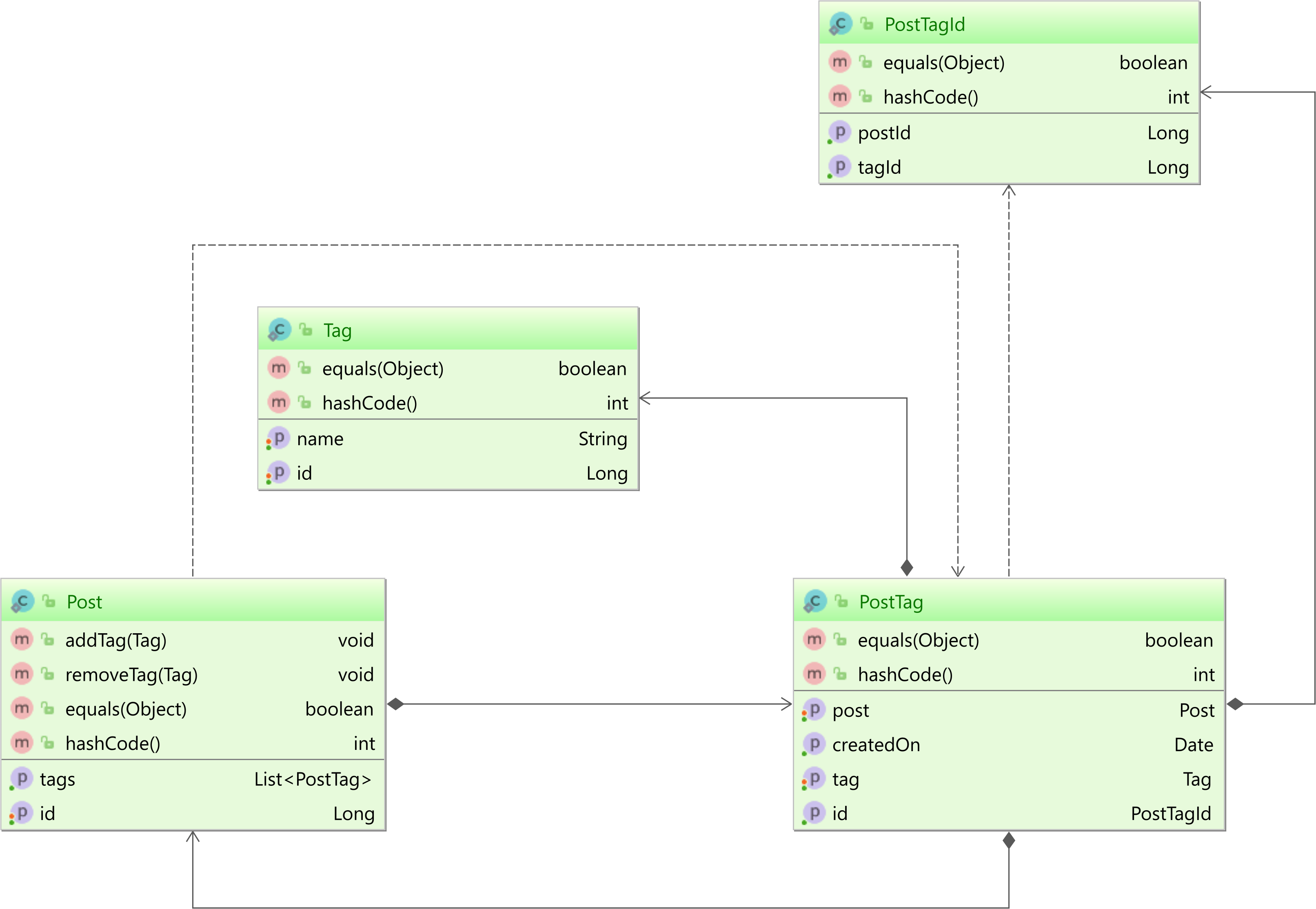
Inserting the PostTag entities is going to render the same SQL statements as seen before.
But when removing the PostTag entity, Hibernate is going to execute a single SELECT query as well as a single DELETE statement:
SELECT p.id AS id1_0_0_,
       p_t.created_on AS created_1_1_1_,
       p_t.post_id AS post_id2_1_1_,
       p_t.tag_id AS tag_id3_1_1_,
       t.id AS id1_2_2_,
       p.title AS title2_0_0_,
       p_t.post_id AS post_id2_1_0__,
       p_t.created_on AS created_1_1_0__,
       p_t.tag_id AS tag_id3_1_0__,
       t.name AS name2_2_2_
FROM   post p
INNER JOIN
       post_tag p_t ON p.id = p_t.post_id
INNER JOIN
       tag t ON p_t.tag_id = t.id
WHERE  p.id = 1

DELETE
FROM   post_tag
WHERE  post_id = 1 AND tag_id = 1
If you enjoyed this article, I bet you are going to love my Book and Video Courses as well.



While mapping the many-to-many database relationship using the @ManyToMany annotation is undoubtedly simpler, when you need to persist extra columns in the join table, you need to map the join table as a dedicated entity.
Although a little bit more work, the association works just as its @ManyToMany counterpart, and this time we can List collections without worrying about SQL statement performance issues.
When mapping the intermediary join table, it’s better to map only one side as a bidirectional @OneToMany association since otherwise, a second SELECT statement will be issued while removing the intermediary join entity.







Great stuff Vlad. I have been using this approach and works great. Is there a way to allow duplicates in the joining table? For example, I want to model a webstore and I need a “customer” to “purchase” the same “item” multiple times. I think we need another primaryKey instead of the embedded one. Thanks a lot!
You’re welcome.
Great article!
Please note that you should also override PostTag.toString() in order to avoid overflow exceptions due to circular references between PostTag.post and Post.tags list objects
Sounds like you have made the mistake of using Lombok for your JPA entities. You don’t need to override
toStringas the default one from Object doesn’t cause any issue.