Transactions and Concurrency Control
Are you struggling with performance issues in your Spring, Jakarta EE, or Java EE application?
What if there were a tool that could automatically detect what caused performance issues in your JPA and Hibernate data access layer?
Wouldn’t it be awesome to have such a tool to watch your application and prevent performance issues during development, long before they affect production systems?
Well, Hypersistence Optimizer is that tool! And it works with Spring Boot, Spring Framework, Jakarta EE, Java EE, Quarkus, Micronaut, or Play Framework.
So, rather than fixing performance issues in your production system on a Saturday night, you are better off using Hypersistence Optimizer to help you prevent those issues so that you can spend your time on the things that you love!
In this article, I’m going to show you how the Hibernate Physical Naming Strategy works and how you can use it to customize the default mapping between entity attributes and database identifiers.
Since version 5, Hibernate offers the PhysicalNamingStrategy interface to customize the mapping between entity attributes and database identifiers.
The Hibernate PhysicalNamingStrategy interface looks as follows:
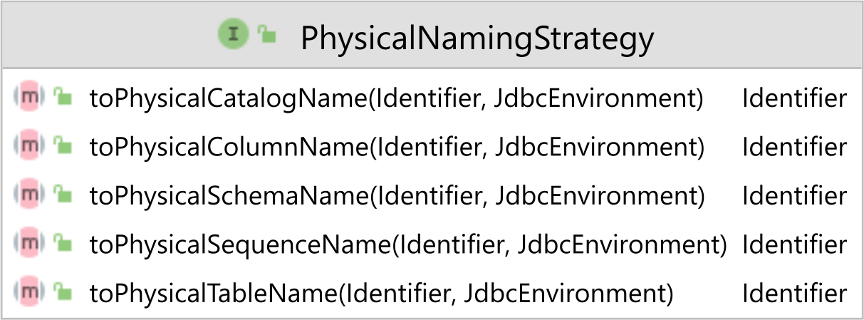
The Hibernate PhysicalNamingStrategy methods allow you to customize the default naming conventions for the following database identifiers:
toPhysicalCatalogName – customize the default database catalog naming conventiontoPhysicalSchemaName – customize the default database schema naming conventiontoPhysicalTableName – customize the default database table naming conventiontoPhysicalSequenceName – customize the default database sequence naming conventiontoPhysicalColumnName – customize the default database table column naming conventionThe default implementation of the PhysicalNamingStrategy interface is the PhysicalNamingStrategyStandardImpl class.
If you want to provide a default camelCase to snake_case mapping between the Java entity attributes and the database identifiers, you can create the following CamelCaseToSnakeCaseNamingStrategy that extends the default PhysicalNamingStrategyStandardImpl class and defines the new default mapping rules:
public class CamelCaseToSnakeCaseNamingStrategy extends PhysicalNamingStrategyStandardImpl {

    public static final String CAMEL_CASE_REGEX = "([a-z]+)([A-Z]+)";
    public static final String SNAKE_CASE_PATTERN = "$1\\_$2";

    @Override
    public Identifier toPhysicalCatalogName(
            Identifier name, JdbcEnvironment context) {
        return formatIdentifier(
            super.toPhysicalCatalogName(name, context)
        );
    }

    @Override
    public Identifier toPhysicalSchemaName(
            Identifier name, JdbcEnvironment context) {
        return formatIdentifier(
            super.toPhysicalSchemaName(name, context)
        );
    }

    @Override
    public Identifier toPhysicalTableName(
            Identifier name, JdbcEnvironment context) {
        return formatIdentifier(
            super.toPhysicalTableName(name, context)
        );
    }

    @Override
    public Identifier toPhysicalSequenceName(
            Identifier name, JdbcEnvironment context) {
        return formatIdentifier(
            super.toPhysicalSequenceName(name, context)
        );
    }

    @Override
    public Identifier toPhysicalColumnName(
            Identifier name, JdbcEnvironment context) {
        return formatIdentifier(
            super.toPhysicalColumnName(name, context)
        );
    }

    private Identifier formatIdentifier(
            Identifier identifier) {
        if (identifier != null) {
            String name = identifier.getText();

            String formattedName = name.replaceAll(
                CAMEL_CASE_REGEX,
                SNAKE_CASE_PATTERN
            ).toLowerCase();

            return !formattedName.equals(name) ?
                    Identifier.toIdentifier(
                        formattedName,
                        identifier.isQuoted()
                    ) :
                    identifier;
        } else {
            return null;
        }
    }
}
If you want to use a camelCase to snake_case naming strategy, you don’t need to create the
CamelCaseToSnakeCaseNamingStrategyas you can get it via the Hypersistence Utils.
If you’re using Spring Boot, then you can register the customer Hibernate PhysicalNamingStrategy via the hibernate.physical_naming_strategy Hibernate configuration property:
spring.jpa.properties.hibernate.physical_naming_strategy=io.hypersistence.utils.hibernate.naming.CamelCaseToSnakeCaseNamingStrategy
Or, if you’re using Java EE or Jakarta EE, then you can provide the Hibernate Physical Naming Strategy via the persistence.xml property file:
<property
    name="hibernate.physical_naming_strategy"
    value="io.hypersistence.utils.hibernate.naming.CamelCaseToSnakeCaseNamingStrategy"
/>
If you enjoyed this article, I bet you are going to love my Book and Video Courses as well.



The Hibernate PhysicalNamingStrategy interface and the hibernate.physical_naming_strategy configuration property allow you to customize the mapping between Java Object and database identifiers.
Therefore, the Hibernate Physical Naming Strategy is useful to define default mappings strategies, as a Java cameCase to database snake_case mapping. For more details about the Hypersistence Utils CamelCaseToSnakeCaseNamingStrategy class, check out this article as well.