What I learned at DevTalks Cluj-Napoca 2026
Are you struggling with performance issues in your Spring, Jakarta EE, or Java EE application?
Imagine having a tool that could automatically detect performance issues in your JPA and Hibernate data access layer long before pushing a problematic change into production!
With the widespread adoption of AI agents generating code in a heartbeat, having such a tool that can watch your back and prevent performance issues during development, long before they affect production systems, can save your company a lot of money and make you a hero!
Hypersistence Optimizer is that tool, and it works with Spring Boot, Spring Framework, Jakarta EE, Java EE, Quarkus, Micronaut, or Play Framework.
So, rather than allowing performance issues to annoy your customers, you are better off preventing those issues using Hypersistence Optimizer and enjoying spending your time on the things that you love!
Introduction
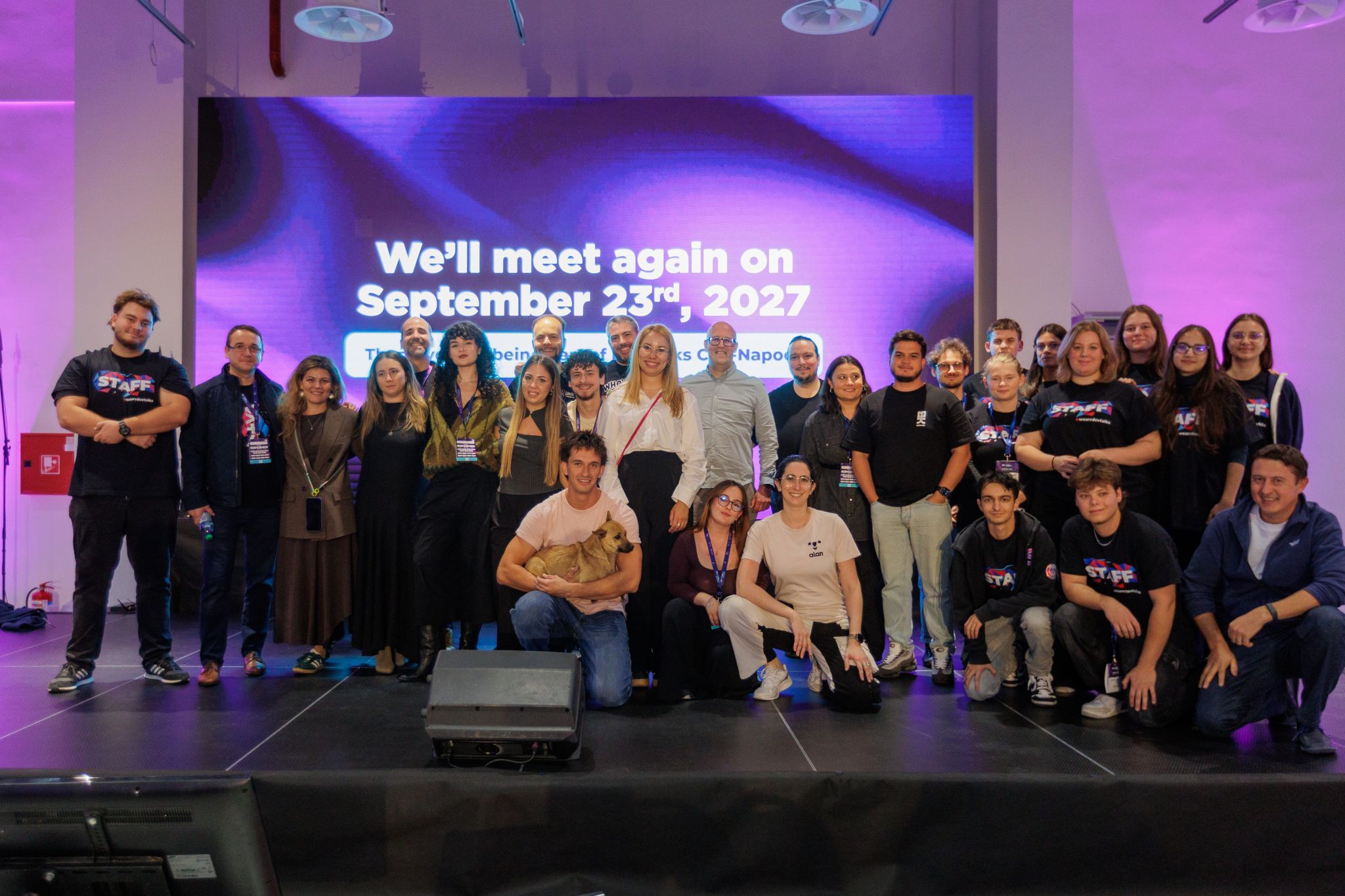
On the 24th of September, I participated in the 9th edition of DevTalks Cluj-Napoca, and since I had a really great time attending this conference, I decided to share what I learned from attending sessions and having conversations with both speakers and participants.
DevTalks
DevTalks runs several conferences throughout Romania, and while the one in Bucharest is very large, featuring 14 stanges, we are lucky to have on in Cluj-Napoca, my home town, which manages to run 3 parallel tracks on which 40 speakers present their latest findings.
This year, the organizers invited me to moderate the Java track, and since my agenda was free for that day, I accepted the invitation. Later, I’ve been invited to give a talk as well and host a panel about the future of Java software development in the age of AI.
The Java sessions
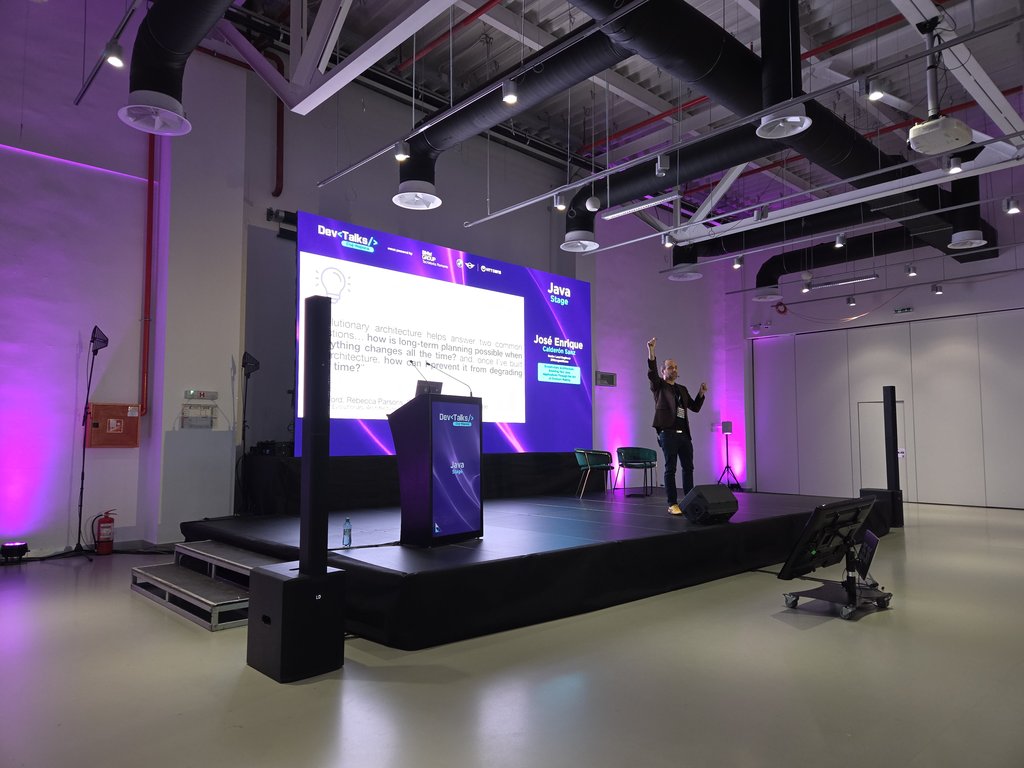
We started the day with José Enrique Calderón Sanz about Evolving Your Java Applications Through the Art of Decision-Making, which showed us how we can apply the wisdom of Antonio Gaudi when making decisions about software architecture.
Next, I did a talk about Modular Monoliths with Spring Modulith. Since microservices architectures are so widely used these days, many times as the default architecture for an enterprise system, I wanted to share a real-life story about how Shopify ended up breaking their monolith into a modular monolith, as opposed to microservices, and why this can be a great default for many Java applications.

The last talk before the lunch break was given by Konrad Szałkowski, who is the co-organizer of the Poznań Java User Group. His talk was about The Hidden Cost of Not Upgrading Java, which was very useful since the attendees got to see what they are missing if they postpone the Java update for too long.
After the lunch break, we continued our sessions with Gabriel Bornea, who showed us how we should treat error handling so that we can cover as many corner cases as possible. From his talk, I got to learn about the fforj project, which augments Java with many functional programming idioms.
Next, we had the honor of listening to Loïc Magnette, the co-organizer of BeJUG, the Belgium Java User Group. His talk was about LangChain4J, a framework that allows you to build AI agents, coordinate them, and monitor their activities.

Afterward, we had a duo with Silviu Cucuiet and Adriel Iclodean, who shared their story of migrating a Java project to .NET, as a training project that allowed them to get familiar with the .NET platform in anticipation for a more complex .NET project that they would have to start working on. I found this approach really useful since it gave them a lot of freedom of experimenting without having to spend a long time ramping up the project learning curve.

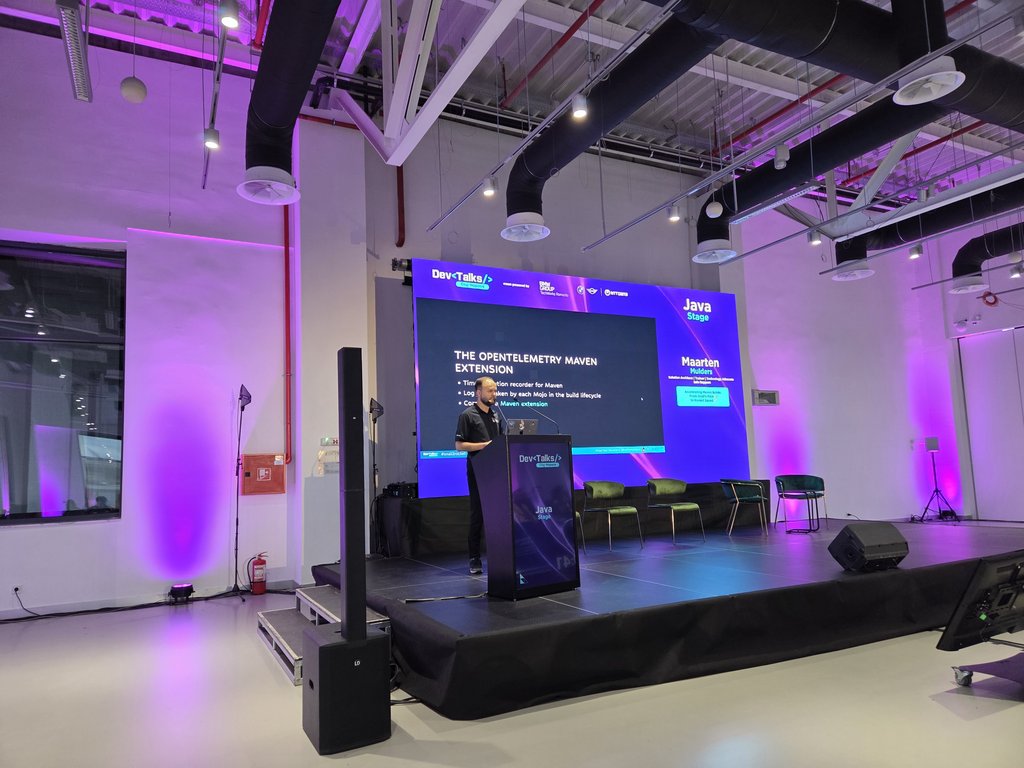
The last session was by the one and only, Maarten Mulders, Java Champion, Oracle ACE Pro, and a frequent speaker at many international software conferences. Maarten’s talk was about accelerating Maven builds using parallel processing, Maven Daemon, and taking advantage of caching. This is a very useful topic that many Java developers should watch since speeding up the build has a great return on investment, specially on very large projects.
The Java panel
To end the Java track on a high note, we organized a panel with José, Konrad, Loïc, and Maarten. Since many developers have a lot of questions about the impact of AI on their careers, and how they should get the best out of it in order to position themselves properly for the next 5 to 10 years, we addressed the panel various questions on this topic, and there were many ideas that I managed to pick from the collective wisdom of the panelists.
There were a tons of things that we went through, as we exceeded the 30-minute time slot by at least 20 minutes.
Here’s a list of things that I managed to get from this extremely valuable discussion we had:
1️⃣ While AI can boost productivity on some specific tasks, great teamwork improves productivity on even more activities. This is like setting up an orchestra, where everyone needs to be tuned and work in synergy.
2️⃣ Writing tests manually can help you add determinism to your project. Generating both the app code and the test with AI may lead to AI writing tests on hallucinations. This is similar to OSS, where we’d write tests for a bug before implementing the fix.
3️⃣ When LLMs regress towards the mean, and everyone uses LLMs, the output would be of average quality, but clients don’t want to pay for average, so expertise will be very valuable to differentiate from the rest.
4️⃣ When prototyping with a new tech, do it on an app that’s unrelated to your business so that management doesn’t promote the prototype to production-ready.
5️⃣ You can use the Maven daemon, parallel tests, and caching to speed up your build significantly.
6️⃣ Use linters and verifiers (e.g., ArchUnit) to speed up reviews, especially now that AI can easily generate lots of changes
7️⃣ Set up a rule in your team so that a PR cannot exceed a threshold of changes (e.g., at most 400 lines of changes), so that it’s easier to review and approve one PR at a time.
8️⃣ AI brings leverage to existing software development practices. If your team has solid software discipline, writes tests, challenges business requirements, and understands customer needs, AI can do wonders. If you have weak spots, AI will make those problems even worse.
Here’s José, Maarten, Loïc, Konrad, and I, taking a group picture after ending the panel.

Awesome, right?
If you enjoyed this article, I bet you are going to love my Book and Video Courses as well.



Conclusion
What a great event it was! Having organized small community events, I can only imagine the effort the organizers had to put into making this conference happen, so I want to take this opportunity to congratulate them.
All in all, we had a blast!