Transactions and Concurrency Control
Are you struggling with performance issues in your Spring, Jakarta EE, or Java EE application?
What if there were a tool that could automatically detect what caused performance issues in your JPA and Hibernate data access layer?
Wouldn’t it be awesome to have such a tool to watch your application and prevent performance issues during development, long before they affect production systems?
Well, Hypersistence Optimizer is that tool! And it works with Spring Boot, Spring Framework, Jakarta EE, Java EE, Quarkus, Micronaut, or Play Framework.
So, rather than fixing performance issues in your production system on a Saturday night, you are better off using Hypersistence Optimizer to help you prevent those issues so that you can spend your time on the things that you love!
Recently, my friend Lukas Eder wrote the following message on Twitter:
5. You don't need inheritance. Especially not entity inheritance.
— Lukas Eder (@lukaseder) June 1, 2017
Just like in any OOP (Object-Oriented Programming) language, entity inheritance is suitable for varying behavior rather than reusing data structures, for which we could use composition. The Domain Model compromising both data (e.g. persisted entities) and behavior (business logic), we can still make use of inheritance for implementing a behavioral software design pattern.
In this article, I’m going to demonstrate how to use JPA inheritance as a means to implement the Strategy design pattern.
Considering we have a notification system that needs to send both email and SMS to customers, we can model the notification relationships as follows:

Both the SmsNotification and EmailNotification inherit the base class Notification properties. However, if we use a RDBMS (relational database system), there is no standard way of implementing table inheritance, so we need to emulate this relationship. Usually, there are only two choices:
For this example, we are going to use the JOINED table approach which has the following database entity relationship diagram:
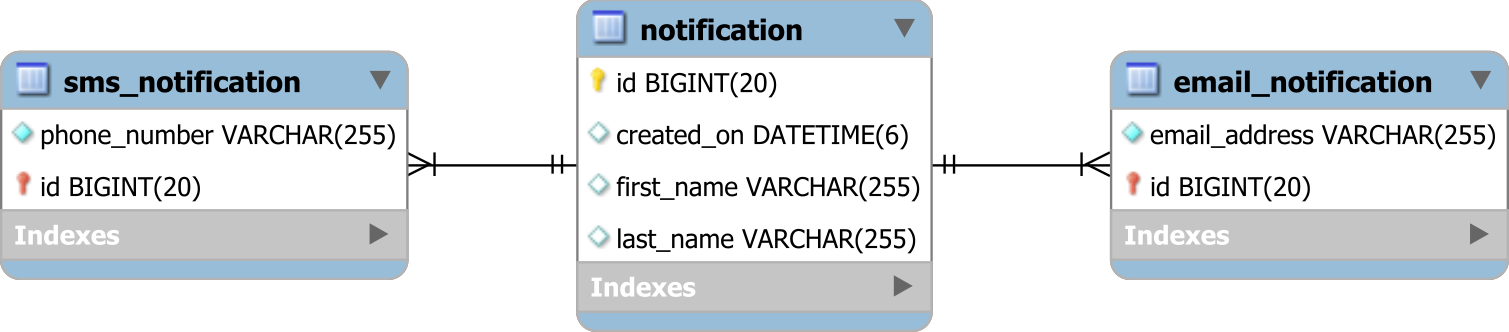
With JPA and Hibernate, mapping the OOP and the RDBMS models is straightforward.
The Notification base class is mapped as follows:
@Entity
@Table(name = "notification")
@Inheritance(
    strategy = InheritanceType.JOINED
)
public class Notification {

    @Id
    @GeneratedValue
    private Long id;

    @Column(name = "first_name")
    private String firstName;

    @Column(name = "last_name")
    private String lastName;

    @Temporal( TemporalType.TIMESTAMP )
    @CreationTimestamp
    @Column(name = "created_on")
    private Date createdOn;

    //Getters and setters omitted for brevity
}
The SmsNotification and EmailNotification mappings looks like this:
@Entity
@Table(name = "sms_notification")
public class SmsNotification
    extends Notification {

    @Column(
        name = "phone_number",
        nullable = false
    )
    private String phoneNumber;

    //Getters and setters omitted for brevity
}
@Entity
@Table(name = "email_notification")
public class EmailNotification
    extends Notification {

    @Column(
        name = "email_address",
        nullable = false
    )
    private String emailAddress;

    //Getters and setters omitted for brevity
}
So far, we only mapped the relationship between the OOP and the RDBMS data structures, but we haven’t covered the actual business logic which is required to send these notifications to our users.
For this purpose, we have the following NotificationSender Service components:

The NotificationSender has two methods:
appliesTo gives the entity that’s supported by this NotificationSendersend encapsulates the actual sending logicThe EmailNotificationSender is implemented as follows:
@Component
public class EmailNotificationSender
    implements NotificationSender<EmailNotification> {

    protected final Logger LOGGER = LoggerFactory.getLogger(
        getClass()
    );

    @Override
    public Class<EmailNotification> appliesTo() {
        return EmailNotification.class;
    }

    @Override
    public void send(EmailNotification notification) {
        LOGGER.info(
            "Send Email to {} {} via address: {}",
             notification.getFirstName(),
             notification.getLastName(),
             notification.getEmailAddress()
        );
    }
}
Of course, the actual sending logic was stripped away, but this is sufficient to understand how the Strategy pattern works.
However, the user does not have to interact with the NotificationSender directly. They only want to send a campaign, and the system should figure out the subscriber channels each client has opted for.
Therefore, we can use the Facade Pattern to expose a very simple API:
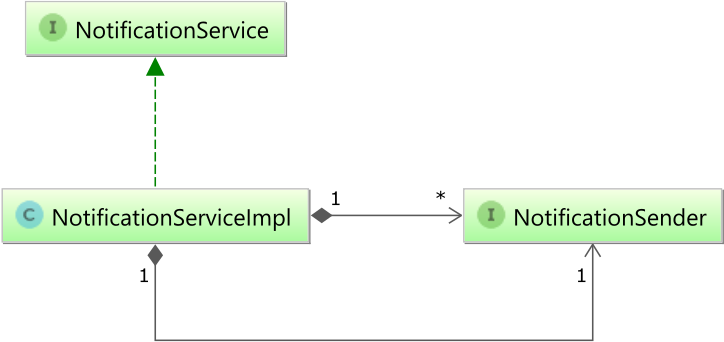
The NotificationSenderImpl is where all the magic happens:
@Service
public class NotificationServiceImpl
    implements NotificationService {

    @Autowired
    private NotificationDAO notificationDAO;

    @Autowired
    private List<NotificationSender> notificationSenders;

    private Map<Class<? extends Notification>, NotificationSender>
        notificationSenderMap = new HashMap<>();

    @PostConstruct
    @SuppressWarnings( "unchecked" )
    public void init() {
        for ( NotificationSender notificationSender : notificationSenders ) {
            notificationSenderMap.put(
                notificationSender.appliesTo(),
                notificationSender
            );
        }
    }

    @Override
    @Transactional
    @SuppressWarnings( "unchecked" )
    public void sendCampaign(String name, String message) {
        List<Notification> notifications = notificationDAO.findAll();

        for ( Notification notification : notifications ) {
            notificationSenderMap
                .get( notification.getClass() )
                .send( notification );
        }
    }
}
There are several things to note in this implementation:
List auto-wiring feature which I explained in my very first blog post. This way, we can inject any NotificationSender the user has configured in our system, therefore decoupling the NotificationService from the actual NotificationSender implementations our system us currently supporting.init method builds the notificationSenderMap which takes a Notification class type as the Map key and the associated NotificationSender as the Map value.sendCampaign method fetches a List of Notification entities from the DAO layer and pushes them to their associated NotificationSender instances.Because JPA offers polymorphic queries, the findAll DAO method can be implemented as follows:
@Override
public List<T> findAll() {
    CriteriaBuilder builder = entityManager
        .getCriteriaBuilder();

    CriteriaQuery<T> criteria = builder
        .createQuery( entityClass );
    criteria.from( entityClass );

    return entityManager
        .createQuery( criteria )
        .getResultList();
}
The system does not have to know which are the actual Notification implementation each client has chosen. The polymorphic query is figured out at runtime by JPA and Hibernate.
If we created the following Notification entities in our system:
SmsNotification sms = new SmsNotification();
sms.setPhoneNumber( "012-345-67890" );
sms.setFirstName( "Vlad" );
sms.setLastName( "Mihalcea" );

entityManager.persist( sms );

EmailNotification email = new EmailNotification();
email.setEmailAddress( "vlad@acme.com" );
email.setFirstName( "Vlad" );
email.setLastName( "Mihalcea" );

entityManager.persist( email );
And now we want to send a campaign:
notificationService.sendCampaign(
    "Black Friday",
    "High-Performance Java Persistence is 40% OFF"
);
Hibernate executes the following SQL query:
SELECT
    n.id AS id1_1_,
    n.created_on AS created_2_1_,
    n.first_name AS first_na3_1_,
    n.last_name AS last_nam4_1_,
    n1_.email_address AS email_ad1_0_,
    n2_.phone_number AS phone_nu1_2_,
    CASE WHEN n1_.id IS NOT NULL THEN 1
         WHEN n2_.id IS NOT NULL THEN 2
         WHEN n.id IS NOT NULL THEN 0
    END AS clazz_
FROM
    notification n
LEFT OUTER JOIN
    email_notification n1_ ON n.id = n1_.id
LEFT OUTER JOIN
    sms_notification n2_ ON n.id = n2_.id
And the following output is logged:
EmailNotificationSender - Send Email to Vlad Mihalcea via address: vlad@acme.com

SmsNotificationSender - Send SMS to Vlad Mihalcea via phone number: 012-345-67890
Cool, right?
If you enjoyed this article, I bet you are going to love my Book and Video Courses as well.



Entity Inheritance is a very useful technique, but only when you use it along with a behavioral software design pattern, such as Strategy or Visitor pattern.
If you only need to propagate certain properties from a base class to all subclasses, you don’t need JPA entity inheritance. All you need is the @MappedSuperclass annotation, but that’s not entity inheritance since the object hierarchy is only visible in the OOP domain, not in the relationship model.