How to enable bytecode enhancement dirty checking in Hibernate
Introduction Hibernate runs the automatic dirty checking mechanism during flush-time, and any managed entity state change is translated into an UPDATE SQL statement. The default dirty checking mechanism uses Java reflection and goes through every property of every managed entity. If the Persistence Context has few entities, this process might go unnoticed, but, if we’re dealing with many entities or the entities have many properties (e.g. a legacy database Domain Model mapping), then the reflection-based dirty checking might have an associated performance impact.
How do JPA and Hibernate define the AUTO flush mode
Introduction The Persistence Context acts as a transactional-write behind cache for the incoming entity state transitions, and all changes are synchronized with the database during flushing. Although both the Hibernate Session and the JPA EntityManager define a flush() method to manually trigger this process, it’s much more convenient to let Hibernate manage the Persistence Context flushing. Unfortunately, there’s is a major difference between how JPA and Hibernate define the automatic flushing mechanism.
How does aggressive connection release work in Hibernate
Hibernate connection providers Hibernate needs to operate both in Java EE and stand-alone environments, and the database connectivity configuration can be done either declaratively or programmatically. To accommodate JDBC Driver connections as well as RESOURCE_LOCAL and JTA DataSource configurations, Hibernate defines its own connection factory abstraction, represented by the org.hibernate.engine.jdbc.connections.spi.ConnectionProvider interface.
How to bootstrap Hibernate without the persistence.xml file
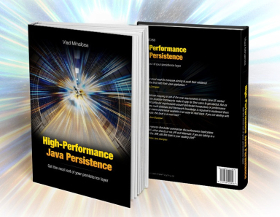
Why? JPA relies heavily on the persistence.xml configuration file, and the standard API to bootstrap a JPA provider programmatically requires too much boilerplate code. While in a typical enterprise application, providing a persistence.xml file is not really an issue, this requirement doesn’t get along with unit testing, especially when tests are completely isolated and they need to validate different aspects of JPA or Hibernate. That was an issue that I bumped into when writing test cases for the High-Performance Java Persistence book. All my tests need to be isolated, and not all… Read More
How does Hibernate Query Cache work
Introduction Now that I covered both Entity and Collection caching, it’s time to investigate how Query Caching works. The Query Cache is strictly related to Entities, and it draws an association between a search criterion and the Entities fulfilling that specific query filter. Like other Hibernate features, the Query Cache is not as trivial as one might think.
How does Hibernate TRANSACTIONAL CacheConcurrencyStrategy work
Introduction In my previous post, I introduced the READ_WRITE second-level cache concurrency mechanism. In this article, I am going to continue this topic with the TRANSACTIONAL strategy.
How does Hibernate READ_WRITE CacheConcurrencyStrategy work
Introduction In my previous post, I introduced the NONSTRICT_READ_WRITE second-level cache concurrency mechanism. In this article, I am going to continue this topic with the READ_WRITE strategy.
How does Hibernate NONSTRICT_READ_WRITE CacheConcurrencyStrategy work
Introduction In my previous post, I introduced the READ_ONLY CacheConcurrencyStrategy, which is the obvious choice for immutable entity graphs. When cached data is changeable, we need to use a read-write caching strategy and this post will describe how NONSTRICT_READ_WRITE second-level cache works.
How does Hibernate Collection Cache work
Introduction Previously, I described the second-level cache entry structure, Hibernate uses for storing entities. Besides entities, Hibernate can also store entity associations and this article will unravel the inner workings of collection caching.