MySQL 8 support for custom SQL CHECK constraints
Are you struggling with performance issues in your Spring, Jakarta EE, or Java EE application?
What if there were a tool that could automatically detect what caused performance issues in your JPA and Hibernate data access layer?
Wouldn’t it be awesome to have such a tool to watch your application and prevent performance issues during development, long before they affect production systems?
Well, Hypersistence Optimizer is that tool! And it works with Spring Boot, Spring Framework, Jakarta EE, Java EE, Quarkus, Micronaut, or Play Framework.
So, rather than fixing performance issues in your production system on a Saturday night, you are better off using Hypersistence Optimizer to help you prevent those issues so that you can spend your time on the things that you love!
Introduction
In this article, we are going to test the MySQL 8 implementation of custom SQL CHECK constraints. Although the CHECK clause is a standard SQL feature, prior to MySQL 8.0.16, the clause was parsed and ignored, so this functionality could only be emulated via BEFORE INSERT and UPDATE triggers.
How to test the MySQL 8 implementation of custom SQL CHECK constraints@vlad_mihalcea https://t.co/4rDn4J6K5p pic.twitter.com/kPWL6aFIZ2
— Java (@java) July 5, 2019
Custom SQL CHECK constraints
As I explained in this article, custom SQL CHECK constraints are very useful to ensure non-nullability constraints for JPA entity subclass-specific attributes when using the SINGLE TABLE JPA inheritance strategy.
To understand the problem, consider we have the following domain model:
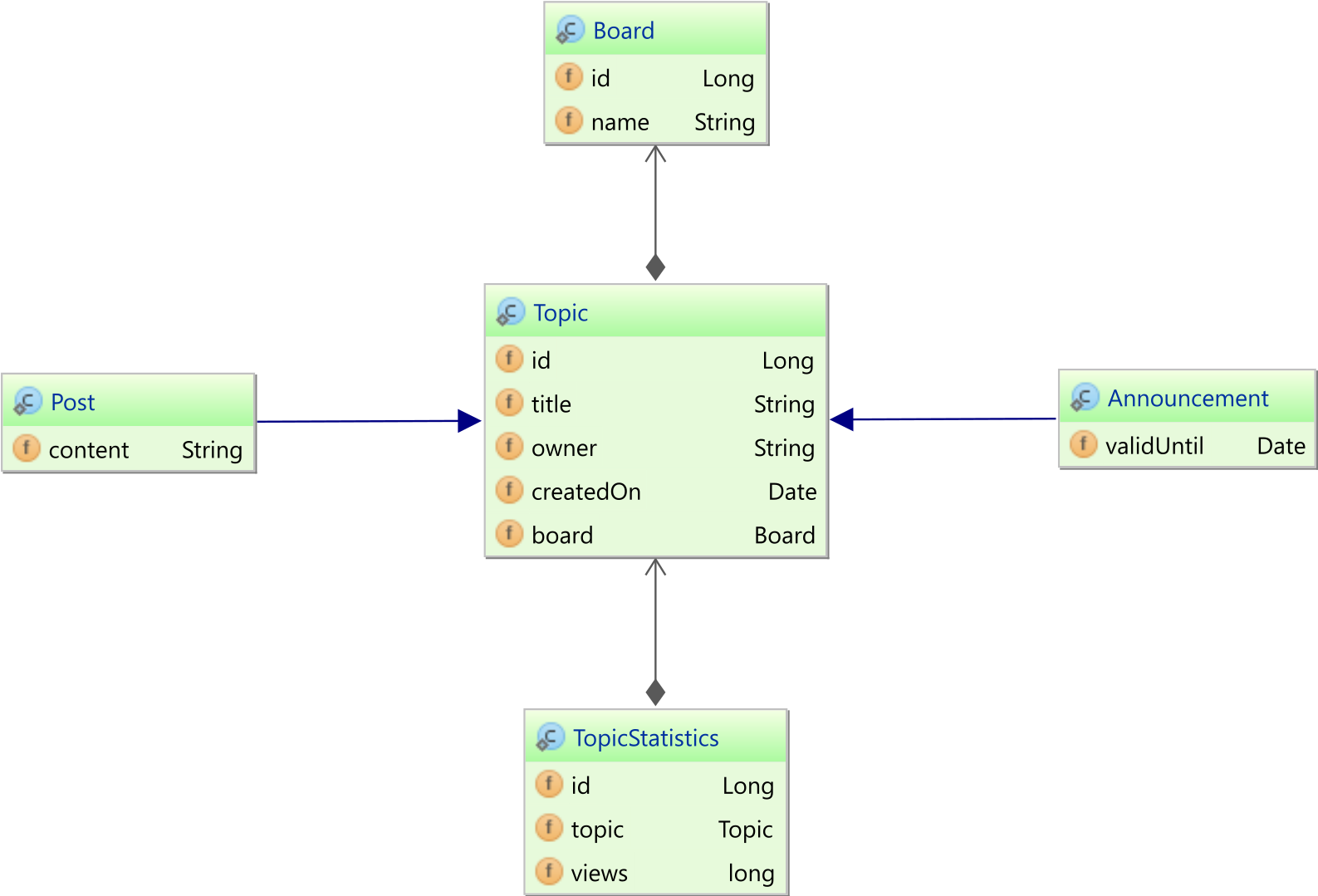
When using the SINGLE TABLE inheritance strategy, the base class and all subclasses share the same database table:

However, if the subclass-specific attributes like the content and validUntil attributes of the Post and Announcement entities are required to be non-nullable, we cannot just add the NOT NULL constraint at the SQL column level as, otherwise, we won’t be able to add a post record as the valid_until column NOT NULL constraint will fail.
That’s exactly where SQL custom CHECK constraints can help us. Therefore, we could add the following two CHECK constraints:
ALTER TABLE topic
ADD CONSTRAINT post_content_check
CHECK (
    CASE
        WHEN DTYPE = 'Post'
        THEN
            CASE
                WHEN content IS NOT NULL
                THEN 1
                ELSE 0
            END
        ELSE 1
    END = 1
)

ALTER TABLE topic
ADD CONSTRAINT announcement_validUntil_check
CHECK (
    CASE
        WHEN DTYPE = 'Announcement'
        THEN
            CASE
                WHEN validUntil IS NOT NULL
                THEN 1
                ELSE 0
            END
        ELSE 1
    END = 1
)
MySQL 8 support for custom SQL CHECK constraints
Now, if we try to persist a Post entity without a valid content property:
entityManager.persist(new Post());
MySQL 8.0.16 is going to throw the following ConstraintViolationException:
INSERT INTO topic (
    board_id,
    createdOn,
    owner,
    title,
    content,
    DTYPE,
    id
)
VALUES (
    NULL(BIGINT),
    '2019-07-03 10:40:03.933',
    NULL(VARCHAR),
    NULL(VARCHAR),
    NULL(VARCHAR),
    'Post',
    4
)

-- SQL Error: 1644, SQLState: 45000
-- Post content cannot be NULL
The same happens if we try to update an existing Post entity and set the content attribute to null:
Post post = entityManager
.createQuery(
    "select p " +
    "from Post p " +
    "where p.content = :content", Post.class)
.setParameter("content", "Best practices")
.getSingleResult();

post.setContent(null);
MySQL 8.0.16 is going to throw a ConstraintViolationException because the custom post_content_check CHECK constraint fails to validate the UPDATE statement:
UPDATE topic
SET
    board_id = 1,
    createdOn = '2019-07-03 10:45:53.581',
    owner = 'John Doe',
    title = 'Inheritance',
    content = NULL(VARCHAR)
WHERE
    id = 2

-- SQL Error: 1644, SQLState: 45000
-- Post content cannot be NULL
Awesome, right?
If you want to see what you had to do to emulate the CHECK constraint on MySQL prior to 8.0.16. then check out this article.
If you enjoyed this article, I bet you are going to love my Book and Video Courses as well.



Conclusion
If you are still using an older version of MySQL, you should definitely consider upgrading to the 8.0 version as there are many features that have been added to MySQL in this major version increment (e.g. Window Functions, SKIP LOCKED and NOWAIT, CTE or Recursive CTE).