A paranoid’s guide to backing up a working folder
Oops time Leanpub supports multiple storage engines, and a private GitHub repository is probably the safest way to the backing up your working folder. I chose Dropbox as I didn’t envision anything wrong with the automatic synchronization mechanism. While working on my book, I accidentally managed to wipe out half of my diagrams, and all changes were instantly synchronized by Dropbox. The free-of-charge Dropbox account doesn’t offer folder-level versioning, so deleted files are simply gone. Fortunately, IntelliJ IDEA Local History saved the day, and the diagrams were properly restored.
How does FlexyPool support both Connection proxies and decorators
Proxies FlexyPool monitors connection pool usage and so it needs to intercept the connection close method call. For simplicity sake, the first version was relying on dynamic proxies for this purpose: As straightforward as it may be, a proxy invocation is slower than a decorator, which calls the target method using a direct invocation. Because all connection pools use proxies anyway, adding another proxy layer only adds more call-time overhead and so now FlexyPool supports connection decorators as well.
Why you should always use connection pooling with Oracle XE
Introduction Oracle Express Edition is the free version of Oracle Enterprise Edition and its smaller size makes it very convenient for testing various Oracle functionalities. According to Oracle documentation, the Express Edition can use at most one CPU and 1 GB of RAM, but in reality, there are other limitations that are not always obvious.
How to translate WordPress blog posts to Leanpub Markdown
Unix tools to the rescue I am a big fan of Unix utilities as they help me out on a daily basis. When the Leanbub WordPress export tool failed me, I knew I had to write my own import script. Without an automatic script, I’d had to spend more than half an hour to fix broken source codes or tables and migrate image references to the book repository folder structure. But the The High-Performance Java Persistence book is using info that’s scattered across over hundreds of blog posts, which would have taken… Read More
Speedment ORM – deliberate enterprise caching
A small company with big dreams I first heard of Speedment while watching a Hazelcast webinar about a RDBMS Change Data Capture approach for updating the in-memory data grid. In this article, we will have the pleasure of talking to Per-Åke Minborg, who is the CTO and one of the founders of Speedment AB.
How does FlexyPool support the Dropwizard Metrics package renaming
Introduction FlexyPool relies heavily on Dropwizard (previously Codahale) Metrics for monitoring the connection pool usage. Being integrated into Dropwizard, the package name was bound to be renamed. So instead of com.codahale.metrics the 4.0.0 release will use the io.dropwizard.metrics package name.
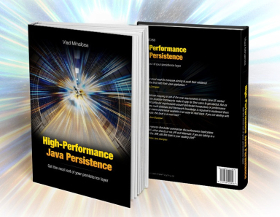
The High-Performance Java Persistence book
A book in the making It’s been a year since I started the quest for a highly-effective Data Knowledge Stack and the Hibernate Master Class contains over fifty articles already. Now that I covered many aspects of database transactions, JDBC and Java Persistence, it’s time to assemble all the pieces together into the High-Performance Java Persistence book.
How to monitor a Java EE DataSource
Introduction FlexyPool is an open-source framework that can monitor a DataSource connection usage. This tool come out of necessity, since we previously lacked support for provisioning connection pools. FlexyPool was initially designed for stand-alone environments and the DataSource proxy configuration was done programmatically. Using Spring bean aliases, we could even substitute an already configured DataSource with the FlexyPool Metrics-aware proxy alternative.
How does Hibernate Query Cache work
Introduction Now that I covered both Entity and Collection caching, it’s time to investigate how Query Caching works. The Query Cache is strictly related to Entities, and it draws an association between a search criterion and the Entities fulfilling that specific query filter. Like other Hibernate features, the Query Cache is not as trivial as one might think.
How does Hibernate TRANSACTIONAL CacheConcurrencyStrategy work
Introduction In my previous post, I introduced the READ_WRITE second-level cache concurrency mechanism. In this article, I am going to continue this topic with the TRANSACTIONAL strategy.